Introduction
MC cables are commonly used for their durability in various applications. But is MC cable a type of cable assembly? In this article, we'll explore the role of MC cables and how they fit into larger electrical systems. You’ll discover the key differences between a single cable type and a full cable assembly.
Understanding MC Cable
What is MC Cable Made Of?
MC cable consists of multiple key components that contribute to its functionality and robustness:
● Insulated Conductors: These are the electrical wires within the cable that carry the current. They are typically made from copper or aluminum and are insulated to prevent short circuits.
● Armor: The outer protective layer of the MC cable is made from interlocking metal tape or a smooth metallic sheath. This provides mechanical protection against physical damage, making it suitable for environments that require extra durability.
● Grounding Conductor: In addition to the regular conductors, MC cables often include a grounding conductor, which is crucial for safety. This ensures that any potential electrical faults are safely directed to the ground.
There are various types of MC cables based on their construction and specific applications:
● Standard MC Cable: Featuring interlocking metal tape armor, this is the most common type and is widely used in general wiring applications.
● Jacketed MC Cable: A type of MC cable that includes an additional layer of non-metallic insulation, making it suitable for wet locations.
● MC-HL Cable: Designed for hazardous locations, MC-HL cable features a gas-tight continuous corrugated metallic sheath for extra protection.
Feature | MC Cable | Cable Assembly |
Definition | A type of electrical cable with insulated conductors and metallic armor | A collection of cables, connectors, and components designed for specific electrical functions |
Components | Insulated conductors, armor, grounding conductor | Multiple wires, connectors, insulation, grounding elements |
Role | Serves as a part of a cable assembly | A complete electrical solution formed by integrating components |
Usage | Used in power, lighting, and control circuits | Used in complex electrical systems across various industries |
Key Differences Between MC Cable and Other Cable Types
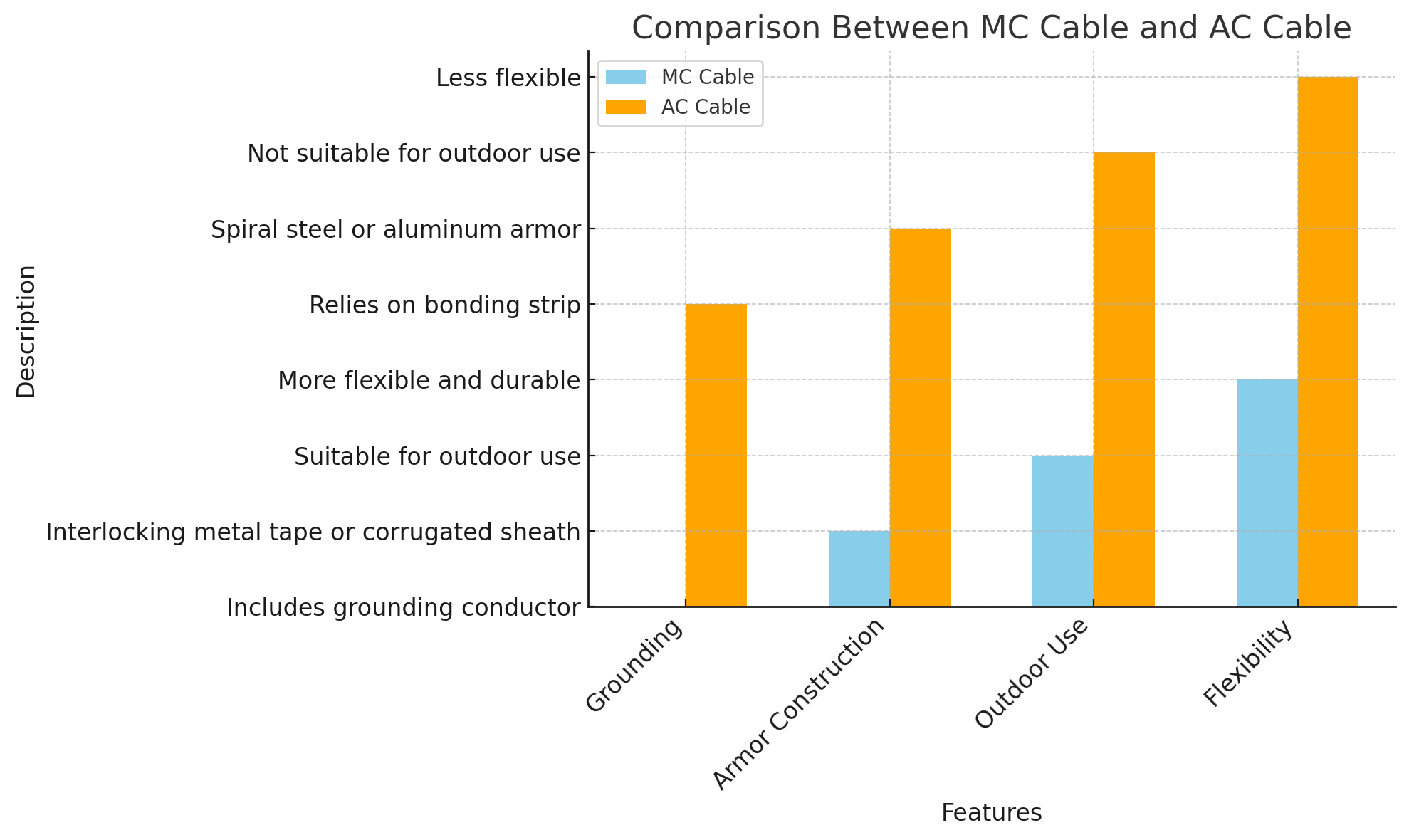
MC cable is often compared to other types of armored cables, such as Armored Cable (AC). Here are the main distinctions:
● Grounding: MC cable includes a grounding conductor, while AC cable relies on a bonding strip in contact with the armor for grounding.
● Armor Construction: MC cable’s armor is typically made from interlocking metal tape or corrugated sheaths, offering greater flexibility and durability compared to AC cable’s spiral armor.
● Application: MC cable is suitable for outdoor use, whereas AC cable is restricted to dry, indoor applications.
This makes MC cable a more versatile and protective choice for installations in challenging environments.
Common Applications of MC Cable
MC cable is used in a wide range of applications:
● Residential: For wiring homes and buildings, particularly where additional protection is necessary.
● Commercial: In commercial buildings, MC cable is often used for power, lighting, and control circuits.
● Industrial: MC cable is ideal for industrial environments, where its durability and resistance to physical damage are essential.
● Hazardous Locations: MC-HL cable, specifically, is designed for use in environments where there is an increased risk of explosion, such as oil rigs or chemical plants.
The National Electrical Code (NEC) has specific guidelines on where MC cables can be used, and their flexibility makes them suitable for a wide variety of setups.
What Is a Cable Assembly?
Defining Cable Assembly
A cable assembly (also known as cable harnessing) refers to a collection of cables, connectors, and related components that are assembled together to perform a specific function. The components are typically pre-wired and arranged to create a more organized, efficient, and safe electrical system. Cable assemblies are essential in applications where multiple connections are required, such as in automotive, aerospace, medical, and industrial systems.
These assemblies help streamline installations by reducing the need for individual wiring and ensuring that the system is properly organized and insulated.
How Does Cable Assembly Differ from a Single Cable Type?
A single cable type, such as MC cable, is a component that performs a specific function, such as carrying electrical current. A cable assembly, on the other hand, is a combination of several cables, connectors, and sometimes other components that work together to meet the requirements of a larger system.
In the case of MC cable, it can be used as part of a cable assembly. For instance, MC cable might be combined with other components such as connectors, junction boxes, and grounding elements to create a fully functional cable assembly designed for specific applications like power distribution or control circuits.
The Importance of Cable Assemblies in Electrical Design
Cable assemblies are critical for ensuring the safety, reliability, and efficiency of electrical systems. They are designed to meet strict standards, ensuring that electrical connections are stable and well-protected. In industries like automotive, medical, and aerospace, the integrity of cable assemblies is paramount.
Cable assemblies allow for:
● Simplified Installation: By reducing the number of individual components needed, cable assemblies streamline the installation process.
● Customization: Assemblies can be tailored to meet specific application needs, such as handling high temperatures or exposure to moisture.
● Improved Safety: Pre-assembled systems reduce the likelihood of improper connections or wiring errors.
Is MC Cable a Cable Assembly?
Defining Cable Assemblies vs. Cable Components
To address the central question—"Is MC cable a cable assembly?"—it’s essential to clarify the difference between a cable assembly and a cable component.
A cable component is any individual part of an electrical system, such as a cable, wire, connector, or terminal. MC cable is a cable component, which means it is a single type of cable that serves a specific purpose within an electrical installation.
A cable assembly, however, is a combination of different components, such as multiple wires, connectors, and insulation, integrated into a single unit designed for a particular application. Therefore, MC cable by itself is not a complete assembly but can be integrated into a larger cable assembly when combined with other components.
MC Cable in the Context of Cable Assemblies
MC cable often becomes part of cable assemblies in more complex electrical systems. When paired with connectors, junction boxes, and grounding components, MC cable contributes to the overall functionality of the system. For example:
● In Power Distribution Systems: MC cable may be used alongside connectors and terminals to create a secure power distribution network.
● In Hazardous Locations: MC-HL cables, when combined with appropriate connectors and grounding systems, form part of specialized assemblies designed for environments with explosive risks.
By using MC cable as part of a larger cable assembly, electrical engineers can create customized solutions that meet the specific needs of the application.
Role of MC Cable in Custom Electrical Solutions
MC cable is often used in custom electrical solutions where specialized protection and grounding are required. For example, in industrial settings where machinery operates in rough environments, MC cable might be integrated into cable assemblies designed for power distribution, control circuits, and safety systems. These assemblies are customized to meet environmental requirements, such as resistance to vibration, moisture, and corrosion.
By tailoring the assembly to fit specific requirements, MC cables play a crucial role in ensuring the reliability and safety of electrical systems.
Types of MC Cables and Their Applications in Cable Assemblies
Standard MC Cable: A Versatile Choice
Standard MC cable, with its interlocking metal armor, is a versatile and widely used cable type. It is commonly used in general wiring applications, particularly for power and lighting circuits. This type of MC cable is flexible, easy to install, and provides robust protection against physical damage, making it a popular choice in residential and commercial buildings.
Hazardous Location (MC-HL) Cable: Specialized Assembly Requirements
For applications in hazardous environments, MC-HL cable is used. This type of cable is specially designed to meet the strict safety standards required in environments where flammable gases or vapors may be present. The armor of MC-HL cable is gas-tight, and it is designed to withstand harsh conditions, making it ideal for use in oil refineries, chemical plants, and mining operations. When assembled into systems with connectors and other components, MC-HL cable helps ensure both safety and reliability in these high-risk areas.
Jacketed and AIA MC Cable: Enhanced Durability and Safety
Jacketed MC cable features an additional layer of protection, making it suitable for wet locations. This cable is often used in outdoor or underground applications, where moisture exposure is a concern. AIA MC cable, with its aluminum interlocked armor, offers added flexibility and mechanical protection, making it ideal for installations in industrial settings where both durability and flexibility are essential.
Type of MC Cable | Armor Type | Application Area | Special Features |
Standard MC Cable | Interlocking metal tape armor | General wiring in residential, commercial, and industrial settings | Durable and flexible for general use |
MC-HL Cable | Continuous corrugated metallic sheath | Hazardous locations | Gas-tight design for explosive or volatile environments |
Jacketed MC Cable | Metallic armor + PVC jacket | Wet locations, outdoor use | Extra protection against moisture |
AIA MC Cable | Aluminum interlocked armor | Industrial settings, harsh environments | Lightweight, high flexibility, and corrosion resistance |
Installation Considerations for MC Cable Assemblies
Compliance with NEC Standards
When installing MC cable, it is critical to adhere to the National Electrical Code (NEC). The NEC outlines specific requirements for the installation of MC cable, including proper grounding, securing, and supporting. For example:
● MC cable must be supported at intervals not exceeding six feet.
● Proper grounding must be ensured to protect against electrical faults.
● Additional requirements apply when MC cables are used in hazardous or outdoor environments.
Ensuring compliance with these standards helps maintain safety and system integrity.
Custom Assembly Installations
For custom installations, MC cables need to be properly assembled with connectors and junction boxes. This involves selecting the appropriate connectors, ensuring that they are correctly crimped or soldered to the cable, and verifying that the entire assembly meets electrical and safety standards.
Advanced Installation Techniques
In specialized environments such as raised floors, hazardous locations, or outdoor installations, extra care must be taken to ensure that the MC cable assembly is robust enough to withstand harsh conditions. This includes selecting cables with appropriate jackets or armor, ensuring proper sealing, and protecting the assembly from exposure to moisture or chemicals.
Benefits and Challenges of Using MC Cable in Cable Assemblies
Advantages of Using MC Cable
MC cable offers several advantages when used in electrical assemblies:
● Protection: The metal armor shields the conductors from physical damage, vibration, and environmental factors.
● Flexibility: MC cable can be routed around corners and obstructions with ease, making it ideal for installations in tight spaces.
● Cost Efficiency: In many cases, MC cable is more cost-effective than other wiring methods, such as conduit systems.
Potential Challenges and Considerations
Despite its many benefits, MC cable has certain limitations:
● Corrosion: In some environments, the metal sheath of MC cable may corrode, necessitating additional protection or special materials.
● Installation Complexity: Installing MC cable can be more complex compared to simpler wiring methods, particularly when it comes to grounding and securing the cable.
Conclusion
MC cable alone is not a complete cable assembly, but it plays a crucial role in many custom electrical solutions. When paired with connectors and grounding components, it becomes part of larger systems that meet specific needs. Understanding its role helps engineers design efficient and reliable systems. TOTEK provides high-quality cable solutions, offering robust products that ensure safety and performance in various applications. Their services help create tailored solutions for both residential and industrial projects.
FAQ
Q: Is MC cable a type of cable assembly?
A: No, MC cable is not a cable assembly on its own. It is a component that is often integrated into a cable assembly, combining with connectors and grounding elements to create a custom electrical solution.
Q: What is a cable assembly?
A: A cable assembly is a collection of wires, connectors, and other components organized to perform a specific function in an electrical system. It provides a complete solution for wiring needs.
Q: How is MC cable used in a cable assembly?
A: MC cable is used as a part of a cable assembly when combined with connectors, grounding elements, and other components, creating a reliable and efficient wiring system for various applications.
Q: Why is MC cable important in cable assemblies?
A: MC cable offers enhanced mechanical protection and grounding, making it a vital part of cable assemblies that require durability and safety in residential, commercial, or industrial setups.
Q: How does MC cable compare to other cable types in cable assemblies?
A: MC cable provides superior protection with its metallic armor, making it a preferred choice over other cables in assemblies where resistance to physical damage and harsh environments is required.


