Introduction
Electrical continuity is crucial in ensuring electrical systems function smoothly. Without it, circuits can't operate, leading to potential malfunctions and safety hazards.
In this article, we’ll dive into what electrical continuity is, why it matters, and how it's tested. You'll also learn how it plays a vital role in maintaining reliable cable assemblies.
Understanding Electrical Continuity
Definition of Continuity in Electrical Terms
In electrical terms, continuity means that an electrical path is complete, allowing current to flow without interruption. This uninterrupted path can be made up of various components, such as wires, connectors, switches, and cable assemblies. When these elements are connected properly, the electrical current can travel from one point to another without any disruptions, ensuring the proper operation of the circuit.
Electrical continuity is governed by Ohm's law, which states that the flow of current is directly proportional to the voltage and inversely proportional to the resistance. Therefore, a continuous electrical path should have low resistance (close to 0 ohms), allowing current to pass through easily. A break in the circuit, such as a disconnected wire or faulty component, causes the resistance to increase significantly, preventing the current from flowing.
What Happens When There Is No Continuity?
When there is no continuity in a circuit, it means that there is a break or fault somewhere along the electrical path. The absence of continuity disrupts the flow of current, rendering the circuit incomplete and causing it to malfunction. This could result in:
● Equipment Failure: A circuit that is not complete cannot power electrical devices or systems, leading to potential failure.
● Safety Hazards: A break in continuity can expose users to electric shocks, fires, or other electrical hazards.
● Component Damage: Without a complete path for current flow, electrical components such as fuses, switches, or transformers may become damaged due to improper current flow or overload.
By identifying and fixing continuity issues early, these risks can be mitigated, ensuring that electrical systems operate safely and efficiently.
Why Is Electrical Continuity Important?
Ensuring Circuit Functionality
Electrical continuity testing is essential for verifying that a circuit is functioning correctly. This testing ensures that the components of the circuit, including wires, connectors, and cable assemblies, are properly connected and capable of carrying current. If continuity is confirmed, it guarantees that the circuit can support the expected electrical load. For instance, in a cable assembly, continuity testing ensures that all connections are intact, preventing unexpected failures in applications where reliable power flow is crucial.
Preventing Electrical Hazards
Continuity testing plays a significant role in preventing electrical hazards. A broken circuit or poor connection can lead to overheating, sparking, or short circuits, all of which pose severe safety risks. By regularly testing for continuity, potential problems such as faulty wiring or improperly connected cable assemblies can be identified and addressed before they lead to dangerous situations like electric shocks or fire outbreaks. This is especially important in environments where safety standards are critical, such as hospitals, industrial plants, or commercial buildings.
Verifying Components
Continuity testing is also vital for verifying individual components in a circuit. Many electrical issues are caused by faulty components like fuses, switches, and wires. By performing continuity tests, technicians can quickly determine whether these components are functioning correctly or if they need replacement. This is particularly important for ensuring the reliability and performance of cable assemblies, which often consist of multiple components that need to work together seamlessly. A continuity test can ensure that every part of the assembly, from the conductors to the connectors, is functioning as intended.
Continuity Testing: How Does It Work?
Overview of Continuity Testing
Continuity testing involves checking whether an electrical path is complete, allowing current to flow. The process is typically done using tools like multimeters or continuity testers. When a continuity tester or multimeter is connected to a circuit, it sends a small current through the circuit. If the circuit is complete, the tester will emit an audible beep or display a low resistance reading, confirming that continuity exists. If the circuit is open or broken, the tester will either show no resistance or emit no sound, indicating that the circuit is incomplete.
Step-by-Step Guide to Continuity Testing
To test for continuity, follow these simple steps:
1. Power off the circuit: Always ensure that the circuit being tested is de-energized to avoid electric shock or damage to the tester.
2. Set the multimeter to continuity mode: Most digital multimeters have a dedicated continuity setting, often marked with a soundwave symbol.
3. Connect the probes: Insert the multimeter's probes into the appropriate ports (black into COM, red into the continuity port).
4. Test the circuit: Place the probes on either end of the component or wire you are testing. If continuity is present, you will hear a beep or see a low resistance reading on the multimeter.
5. Check for breaks: If there is no beep or a high resistance reading, it indicates a break in the circuit.
Step Number | Action | Description |
1 | Power off the circuit | Ensure the circuit is not energized before testing. |
2 | Set the multimeter to continuity mode | Select the correct setting on the multimeter. |
3 | Connect the probes to the circuit points | Touch the leads to both ends of the circuit. |
4 | Interpret the reading | Beep indicates continuity; no sound means a break. |
Safety Precautions When Testing Continuity
Before testing for continuity, always take the necessary safety precautions:
● Turn off the power: Ensure the circuit is not energized to prevent electrical shock.
● Discharge capacitors: Capacitors can store electrical energy even when the circuit is turned off. Discharge them before testing.
● Use proper tools: Ensure that your multimeter or continuity tester is functioning properly and that you are using it correctly.
By following these steps, continuity testing can be performed safely and effectively, helping to identify faults in electrical systems.
Tools for Electrical Continuity Testing
Using a Digital Multimeter for Continuity Testing
A digital multimeter (DMM) is one of the most versatile tools for continuity testing. It can measure voltage, current, resistance, and continuity. Most DMMs have a continuity mode that emits a beep when a complete path is detected. This function is ideal for testing cables, fuses, switches, and other electrical components.
When using a DMM for continuity testing, ensure that the device is set to the correct mode, typically indicated by a diode or soundwave symbol. A digital multimeter is particularly useful when testing complex systems like cable assemblies because it can also measure resistance, allowing technicians to identify weak or partial connections in the system.
Continuity Testers vs. Multimeters
While a continuity tester is a more specialized tool designed specifically for testing continuity, a digital multimeter offers more functionality. Continuity testers are typically simpler, with a single function: to check if a circuit is complete. They are easy to use and often feature an audible signal when continuity is detected.
In contrast, a digital multimeter is a multifunctional tool that can measure multiple electrical parameters, making it more versatile in diagnosing a wide range of electrical issues. However, it may require more training to use effectively. Both tools are useful for continuity testing, but for general troubleshooting and more comprehensive testing, a digital multimeter is the preferred option.
Tool Type | Features | Best For | Accuracy Level |
Digital Multimeter | Measures voltage, current, resistance, and continuity. | General troubleshooting and component testing. | High |
Continuity Tester | Simple tool for testing continuity. Emits sound for closed circuits. | Quick checks for continuity. | Moderate |
Common Applications of Electrical Continuity
Household and Industrial Applications
Continuity testing is essential for both household and industrial electrical systems. In residential settings, it helps ensure that electrical wiring is correctly installed and free of breaks or faults. For example, continuity tests can verify that outlets, light switches, and circuits are fully connected and functioning.
In industrial environments, continuity testing is crucial for maintaining large electrical systems that power machinery and critical equipment. Regular testing ensures that cable assemblies used in these systems are reliable and capable of handling the required electrical load without interruptions.
Continuity in Cable Assemblies
Cable assemblies play a critical role in modern electrical systems by connecting various components within circuits. Continuity testing is especially important in these assemblies to ensure that all connections are intact and capable of carrying current. A faulty cable assembly can lead to system failures or electrical hazards.
By testing the continuity of a cable assembly, technicians can confirm that each conductor is properly connected and that no breaks or shorts exist within the wires or connectors. This is essential for maintaining the overall reliability and safety of electrical systems, particularly in complex industrial or commercial setups.
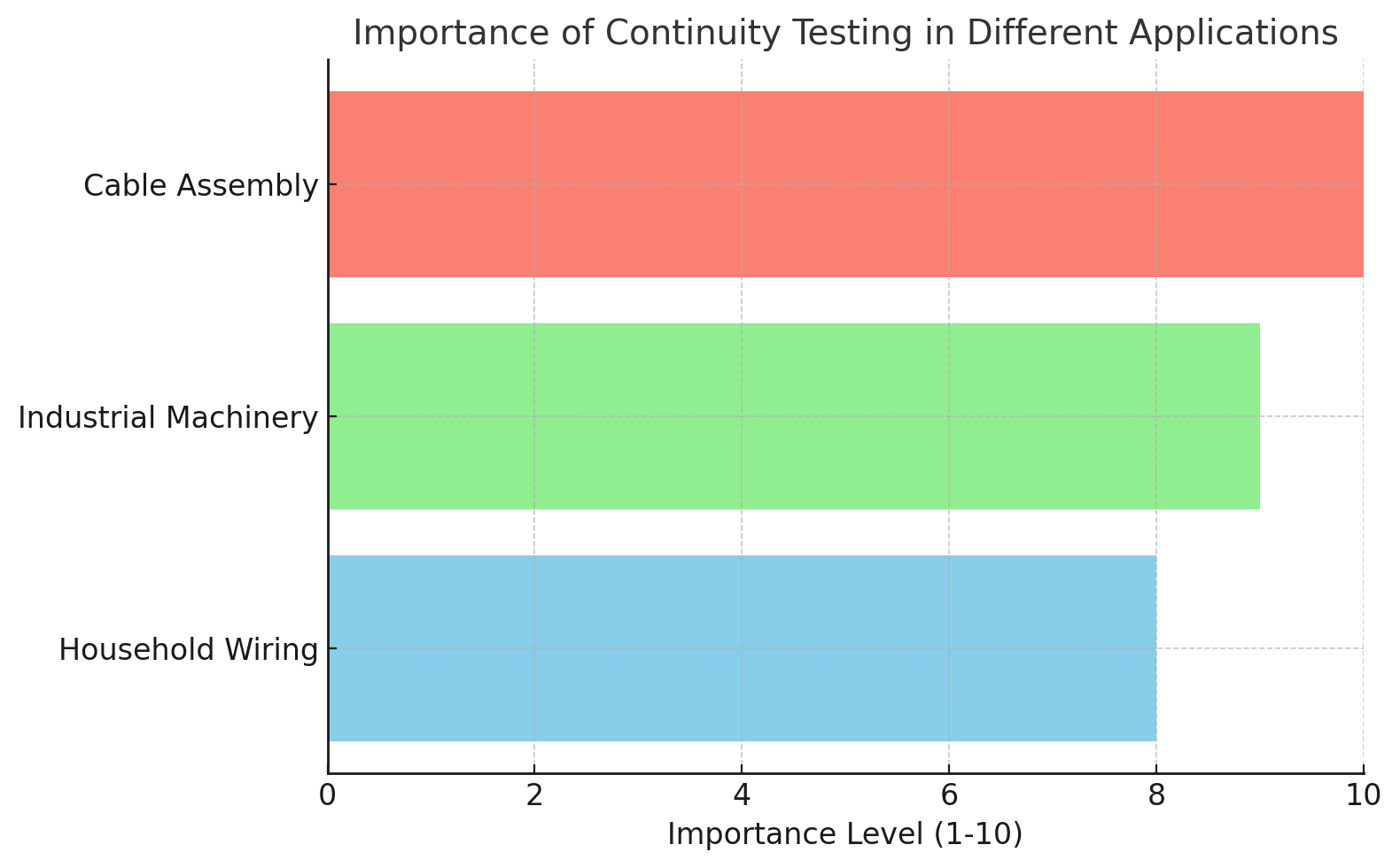
Application | Description | Importance |
Household Wiring | Ensures proper connections in circuits. | Prevents electrical hazards and ensures functionality. |
Industrial Machinery | Verifies power systems and motor circuits. | Avoids downtime and system failures. |
Cable Assembly | Tests connections in complex electrical systems. | Maintains reliability and prevents faults. |
Benefits of Continuity Testing
Efficiency in Troubleshooting
Continuity testing is a quick and efficient way to identify faults in electrical systems. Whether it's a broken wire, a faulty fuse, or a damaged switch, continuity testing can pinpoint the problem, allowing technicians to take immediate action. This efficiency is particularly valuable in industries where downtime can be costly, as it helps minimize repair times and prevent system failures.
Reliability in Maintenance
Routine continuity testing is crucial for maintaining the long-term reliability of electrical systems. By regularly testing circuits and cable assemblies, you can identify issues before they lead to failures, preventing costly repairs and ensuring the smooth operation of electrical equipment. This proactive maintenance approach helps ensure that systems remain functional and safe over time.
Conclusion
Electrical continuity ensures that circuits function correctly by allowing current to flow through an unbroken path. Continuity testing helps prevent equipment failures and safety risks by verifying circuit integrity. Understanding and regularly testing continuity is vital for maintaining safe, reliable electrical systems. Proper maintenance of cable assemblies also plays a critical role in preventing system breakdowns and optimizing performance. For industries such as manufacturing and automation, investing in quality cable assemblies and routine continuity testing from companies like TOTEK can enhance system reliability and minimize downtime.
FAQ
Q: What is electrical continuity?
A: Electrical continuity refers to the uninterrupted path that allows electric current to flow through a circuit. It ensures that all components, including cable assemblies, are properly connected for optimal current flow.
Q: How does continuity affect a cable assembly?
A: Continuity ensures that a cable assembly functions properly by allowing current to flow without interruption. A break in continuity can cause malfunction or failure in the electrical system.
Q: Why is electrical continuity important in electrical systems?
A: Continuity is essential for the safe operation of electrical systems. It prevents issues like equipment failure and hazards, ensuring the proper flow of electricity through components, including cable assemblies.
Q: How do you test for electrical continuity?
A: To test for continuity, use a digital multimeter or continuity tester. For cable assemblies, connect the multimeter leads to the ends of the cable, and check for an audible beep or low resistance.
Q: What can cause a lack of continuity in a cable assembly?
A: A break, corrosion, or loose connection in a cable assembly can disrupt continuity. This prevents proper electrical flow and can lead to circuit failure or safety risks.
Q: Can continuity testing prevent electrical hazards?
A: Yes, continuity testing helps identify faults in circuits, including in cable assemblies, before they cause issues like electric shocks, fires, or system malfunctions.


