As the world shifts to electric cars, a new kind of part has become very important: the automotive high-voltage (HV) wire harness. You can think of it as the main artery of an electric vehicle (EV). It carries the high-power electricity from the battery to the motor and other key parts.
If you are a buyer or engineer in the automotive industry, understanding the HV wire harness is critical. It is not just a bunch of wires. It is a complex, safety-critical system. This guide will explain everything you need to know.
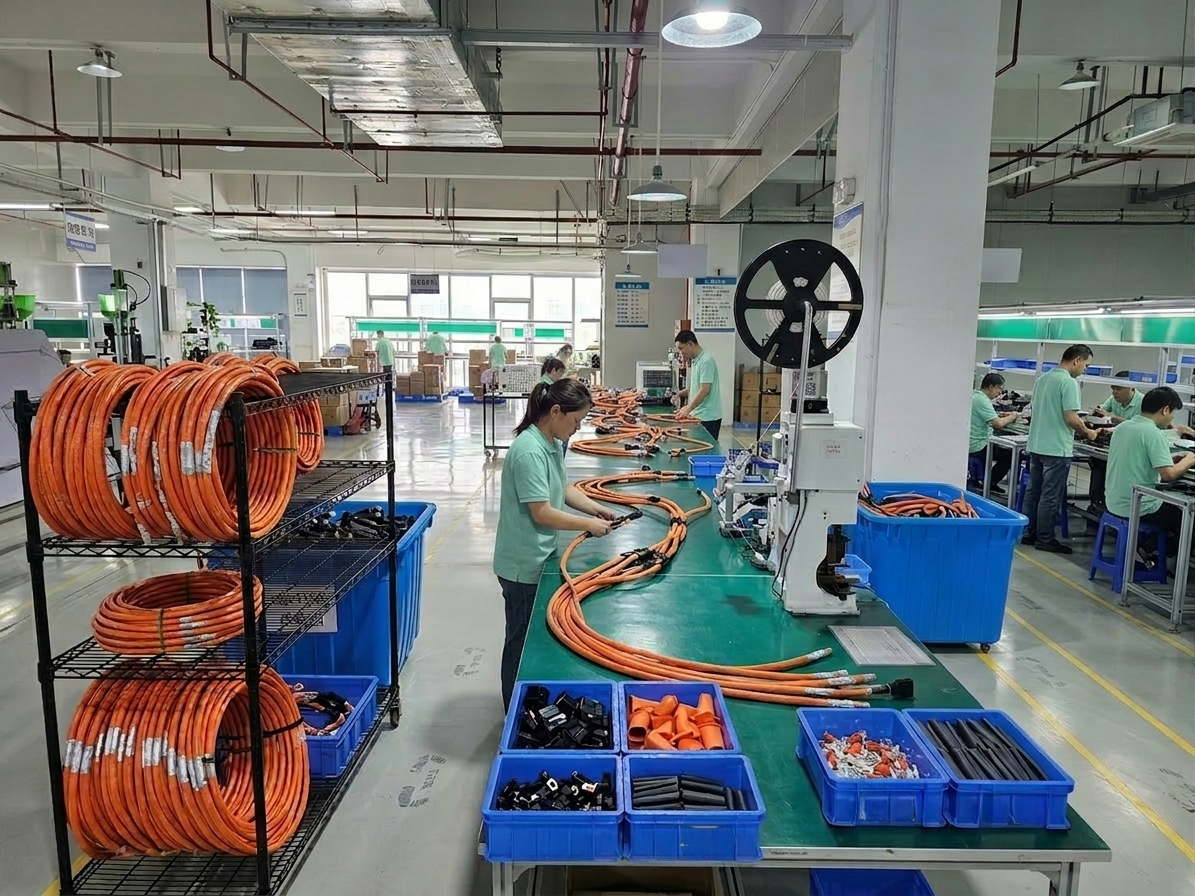
What is the Difference Between a High-Voltage and Low-Voltage Harness?
Every car has a wire harness, but the one in an EV is special. It has two parts: low-voltage (LV) and high-voltage (HV). The LV system is the same as in a normal gasoline car (12V). It powers the lights, radio, and windows.
The HV system is what makes an EV an EV. It works at much higher voltages, typically 400V to 800V. This high power is needed to drive the electric motor.
Here is a simple comparison:
Feature | Low-Voltage (LV) Harness | High-Voltage (HV) Harness |
Main Job | Signal & Control | Power Transmission |
Voltage | 12V / 24V DC | 400V - 1000V DC |
Cable Size | Thin (0.35 - 6.0 mm²) | Thick (35 - 95 mm²) |
Protection | Tape / Plastic Tube | Orange Jacket + EMI Shield |
Key Test | Continuity | Hi-Pot (High Voltage Test) |
Safety Risk | Low | Critical (Electric Shock) |
As you can see, the HV harness is built for safety and high power. It uses thick cables, special orange color coding (a global standard), and heavy-duty protection to prevent electrical interference (EMI) and keep people safe.
Where is the HV Wire Harness Used in an EV?
The HV wire harness connects all the main parts of an electric car. Think of it as the EV’s central nervous system for power.
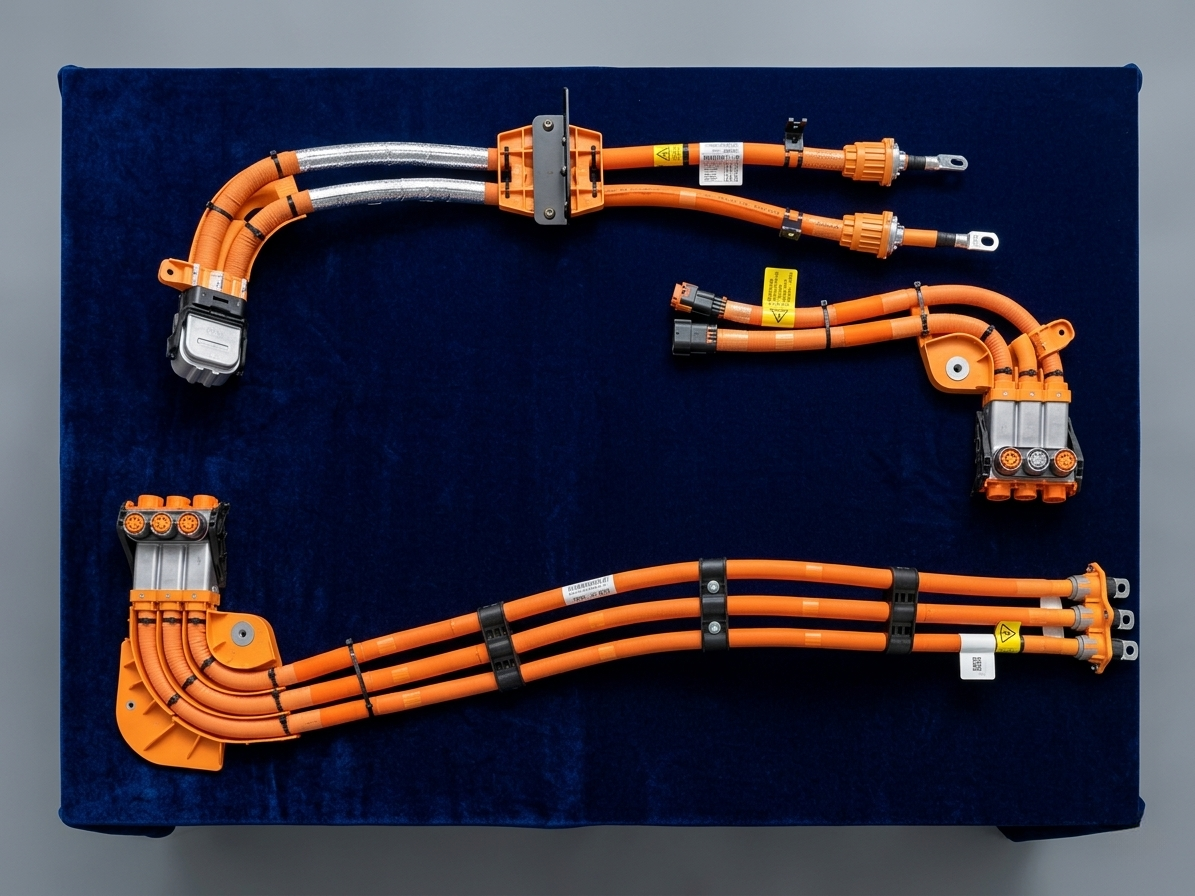
Key connections include:
• HV Battery Pack: The heart of the EV. The harness connects the battery to the inverter and power distribution unit (PDU).
• Inverter: This converts DC power from the battery to AC power for the motor. It handles very high currents.
• Traction Motor: This drives the wheels. It is connected to the inverter with thick, vibration-resistant HV cables.
• Charging Port: This is where you plug in the car. The harness connects the port to the battery (for DC fast charging) or the on-board charger (for AC charging).
• Auxiliary Systems: It also powers other high-voltage parts like the A/C compressor and the cabin heater (PTC Heater).
Quality Standards are Everything
Because the HV wire harness is so important for safety, it must meet very strict international quality standards. A failure here is not an option. For a professional manufacturer, these standards are not just a customer request; they are the foundation of the entire production process.
At Totek, we build our harnesses to meet the toughest global automotive standards:
Standard | Organization | What It Covers |
IATF 16949 | IATF | The global quality management standard for the automotive industry. |
IPC/WHMA-A-620 | IPC | The most important standard for cable and wire harness assembly quality. |
USCAR-21 / 38 | SAE / USCAR | American standards for crimping and ultrasonic welding quality. |
ISO 20653 (IP Code) | ISO | Testing for protection against water and dust (IP67 / IP69K). |
ISO 6722 / 19642 | ISO | Standards for the high-voltage cables themselves. |
When you choose a supplier, make sure they are certified and can prove they follow these standards. This is the only way to guarantee safety and reliability.
How is an HV Wire Harness Made?
The manufacturing process for an HV harness is much more complex than for a simple cable. It requires special equipment and highly trained workers.
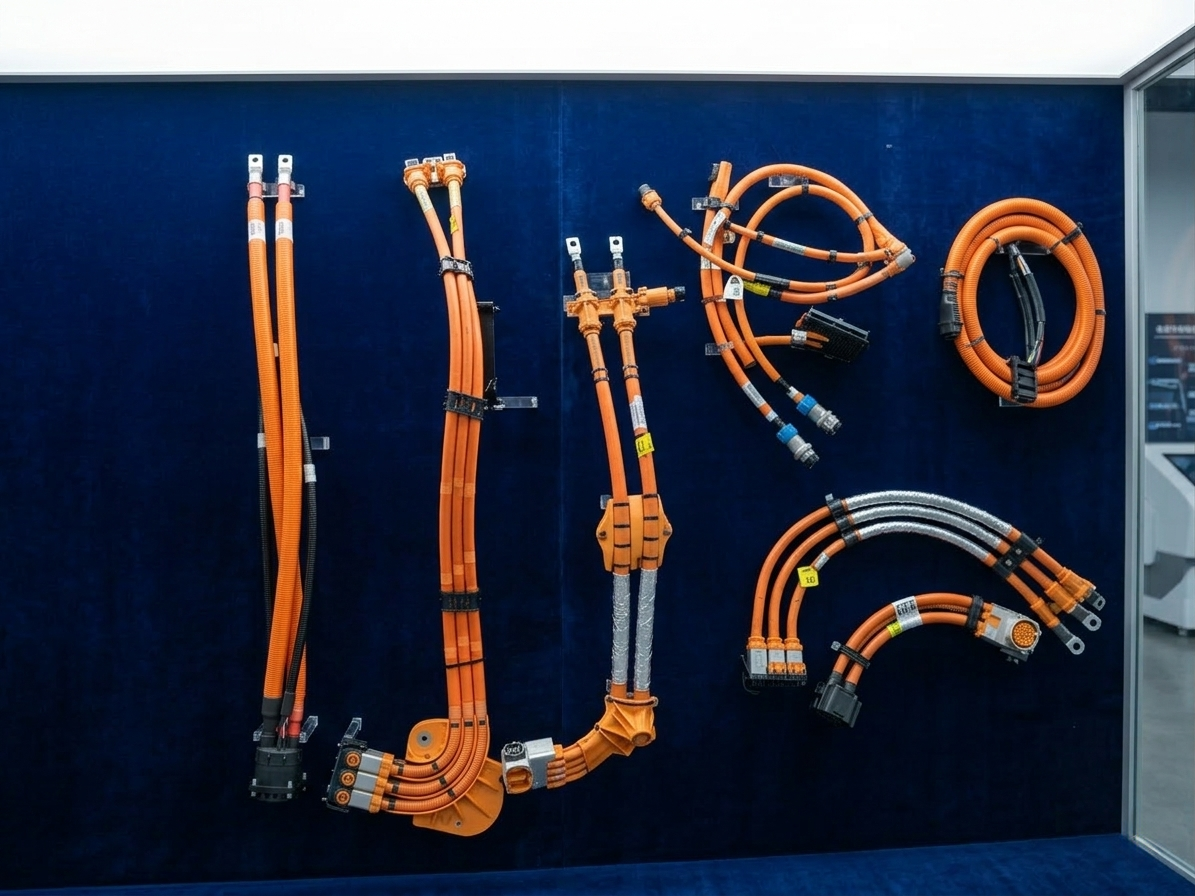
The key steps include:
1 Wire Cutting: The thick, orange HV cable is cut to the exact length needed.
2 Stripping & Shield Processing: The outer jacket, EMI shield (braid and foil), and inner insulation are carefully stripped back without damaging the conductor.
3 Crimping or Welding: The terminals (the metal ends) are attached. For large cables, this is done with a powerful hydraulic crimping press or through ultrasonic welding for the strongest possible connection.
4 Connector Assembly: The terminals are inserted into the special HV connectors.
5 Assembly Board: The harness is laid out on a 3D assembly board to give it the exact shape it needs to fit inside the car.
6 Testing: This is the most critical part. Every single harness must pass 100% End-of-Line (EOL) testing.
100% Testing for Zero Defects
At Totek, our goal is zero defects. We achieve this through a multi-step testing process for every harness we make:
• Hi-Pot (Dielectric) Test: We apply a very high voltage (e.g., 3000V) to make sure there are no leaks in the insulation.
• Leakage Test: We use an air decay test to ensure every connection is perfectly sealed and meets IP67 waterproof standards.
• Continuity & Resistance Test: We check that all connections are correct and the electrical resistance is extremely low.
• Crimp Force Monitoring: During production, our machines monitor the force of every single crimp to ensure it is perfect.
• Visual Inspection: Every harness is visually inspected by a trained operator before it is packaged.
This combination of automated monitoring and human inspection is how we can confidently supply major automotive OEMs around the world.
Choose a Partner You Can Trust
Building a safe and reliable electric vehicle requires partners who understand the demands of the automotive industry. The HV wire harness is a component where quality cannot be compromised.
As a specialized manufacturer with IATF 16949 certification and a deep focus on high-voltage systems, Totek is a trusted partner for global OEMs. We offer:
• Engineering Depth: We work with your team from the start to design for manufacturing (DFM) and optimize for cost and performance.
• Proven Quality: Our processes are built on IPC-A-620 and USCAR standards, with a goal of 0 PPM (parts per million) defects.
• Scalable Capacity: Our flexible production lines can handle everything from rapid prototypes to high-volume mass production.
If you are looking for a reliable manufacturing partner for your next EV project, our team is ready to help.
Contact Totek Today to Discuss Your HV Harness Needs


