Introduction
Did you know that cable assemblies and wire harnesses, though often used interchangeably, are quite different? These components serve distinct purposes in electrical systems.
In this article, we’ll break down the differences between cable assemblies and wire harnesses. You'll learn when to choose each for optimal performance and cost-effectiveness.
What is a Cable Assembly?
Definition and Core Purpose
A cable assembly is a collection of wires or cables that are grouped together and enclosed in a protective sheath. The purpose of a cable assembly is to streamline the transmission of electrical power or signals between systems, ensuring that connections remain secure and organized. This type of assembly can be found in a wide variety of industries, including telecommunications, automotive, aerospace, and industrial manufacturing.
Cable assemblies are typically designed for environments where durability and protection are critical. For example, in high-performance systems like aerospace or military electronics, the cable assembly will provide both the necessary connections and insulation to protect the system from environmental elements like temperature changes, moisture, and physical stress.
Key Components of a Cable Assembly
A typical cable assembly includes several key components:
● Wires or Cables: These serve as the primary conductors of electrical signals or power.
● Connectors: These components are used to join the cable assembly to other systems or devices.
● Insulation: Protective layers around the wires or cables prevent electrical short circuits and ensure safety.
● Protective Sheaths: In cable assemblies, robust outer layers such as thermoplastic or rubber provide additional protection from harsh environmental conditions like moisture or mechanical stress.
These components work together to provide a reliable, safe, and efficient solution for power and signal transmission.
What is a Wire Harness?
Definition and Core Purpose
A wire harness is an assembly of wires or cables grouped together for the purpose of organizing and transmitting electrical power or signals. Unlike a cable assembly, which is typically point-to-point, a wire harness is often designed with multiple branching cables, allowing for a more complex routing of wires within a system.
Wire harnesses are commonly used in applications where multiple connections need to be made within a compact space, such as in automotive wiring systems, household appliances, and industrial machinery. Their primary function is to simplify the installation process by keeping the wiring organized and secure, reducing clutter, and minimizing the risk of electrical shorts.
Key Components of a Wire Harness
Wire harnesses generally include the following components:
● Wires and Cables: These are the core conductors of electrical power or signals, often insulated to prevent damage.
● Connectors: Used to join the wire harness to different electrical components or systems.
● Protective Coverings: Wire harnesses may be wrapped in materials like thermoplastic or other protective sheaths to safeguard the wires from abrasion, moisture, or environmental stress.
● Cable Ties or Lacing: These elements help bind the wires together, keeping them organized and preventing movement within the harness.
Wire harnesses are designed to withstand mechanical stress, especially in automotive or industrial environments where vibration and movement are common.
Physical Differences Between Cable Assemblies and Wire Harnesses
Layout and Structure
The most notable physical difference between a cable assembly and a wire harness is their layout and complexity:
● Cable Assemblies: Typically consist of point-to-point connections. The wires are often arranged in a linear fashion, and the assembly may include connectors at each end. Cable assemblies are simpler and designed for specific applications requiring minimal internal wiring.
● Wire Harnesses: Are more complex and consist of multiple wires that branch out in different directions. They are designed for larger systems where various components need to be connected in multiple locations. Wire harnesses are more suitable for organizing and routing complex wiring systems, making them ideal for automotive, aerospace, and industrial applications.
Protection and Durability
● Cable Assemblies: These assemblies usually feature heavy-duty protective layers like thermoplastic or thermoset plastic. This outer sheath offers greater protection, especially in environments where durability is critical (e.g., aerospace, military, or outdoor industrial applications).
● Wire Harnesses: Typically provide basic protection for the wires inside but may not be as robust as cable assemblies. They are designed to keep wires organized and prevent tangling but may not offer the same level of protection against extreme conditions.
Flexibility and Design
● Cable Assemblies: Tend to be more flexible due to their simpler design and point-to-point connections. They can be tailored to specific needs and environments, such as smaller spaces or applications requiring frequent movement.
● Wire Harnesses: While flexible in terms of organization, wire harnesses are less flexible in terms of design and are often more rigid because they are intended to keep multiple wires in a fixed configuration. This makes them ideal for installations where movement is minimal.
Feature | Cable Assembly | Wire Harness |
Complexity | Simpler, point-to-point connections | More complex, multi-branch structure |
Protection | Higher protection with robust sheaths | Basic protection with simpler coverings |
Flexibility | Designed for tight spaces and performance | More flexible, ideal for large-scale organization |
Cost | More expensive due to materials & process | More cost-effective, ideal for high-volume production |
Applications | High-performance, industrial, aerospace | Low-cost, automotive, household appliances |
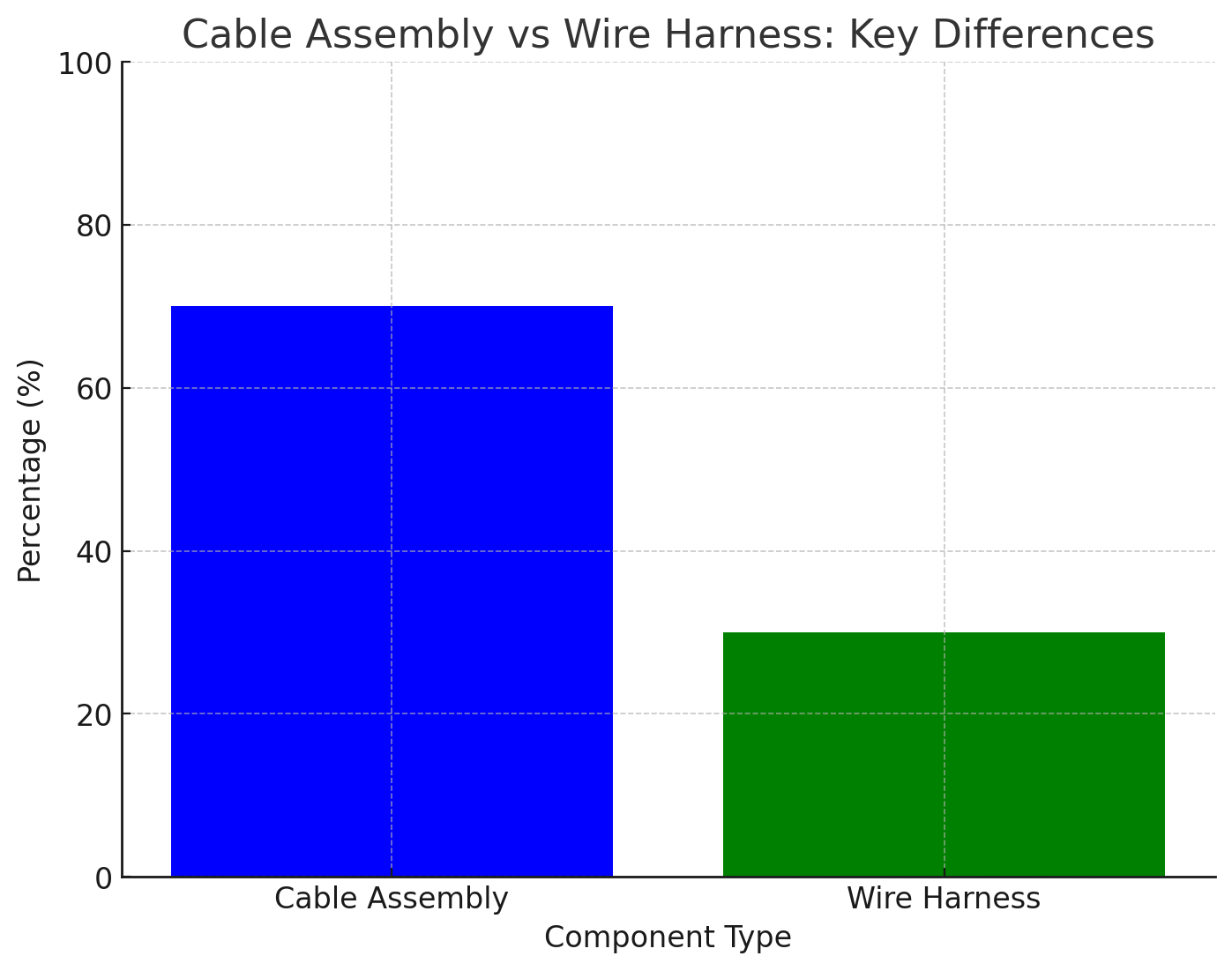
Manufacturing Processes: Cable Assembly vs. Wire Harness
Production Process for Cable Assemblies
The manufacturing process for cable assemblies is relatively straightforward and often automated. The steps typically include:
● Cutting the cable to the required length.
● Stripping the insulation from the wire ends.
● Terminating the wires with connectors using crimping, soldering, or other methods.
Automation plays a significant role in the production of cable assemblies, particularly when the requirements are standardized. This results in higher efficiency and lower costs for large-scale production.
Production Process for Wire Harnesses
The production of wire harnesses is more complex and often involves manual labor. The process includes:
● Routing wires onto a board.
● Cutting, stripping, and terminating wires, sometimes by hand.
● Binding the wires together using cable ties, laces, or protective sheathing.
Wire harness production often requires more space and labor, especially for large or complex harnesses. The process is less automated than cable assembly production, and the complexity of the harness design can make it more time-consuming.
Process Step | Cable Assembly | Wire Harness |
Cutting | Automated, minimal human labor | Manual, more labor-intensive |
Stripping | Automated machinery | Manual stripping for each wire |
Termination | Automated crimping and soldering | Manual crimping and complex routing |
Assembly Complexity | Simple, minimal routing | Complex routing with multiple connections |
Application Differences: When to Choose a Cable Assembly vs. Wire Harness
Applications Best Suited for Cable Assemblies
Cable assemblies are ideal for applications where high-performance, flexibility, and protection are needed in a compact form. These applications include:
● Aerospace: Where extreme environmental conditions require high protection.
● Medical Devices: Where reliability and performance are essential in critical equipment.
● Telecommunications: For efficient signal transmission with minimal interference.
Applications Best Suited for Wire Harnesses
Wire harnesses are better suited for applications where organizing and routing many wires is necessary, such as:
● Automotive: For organizing and routing wiring systems in vehicles.
● Consumer Electronics: In appliances where multiple connections need to be made quickly and cost-effectively.
● Industrial Machinery: For large-scale manufacturing where organizing complex wiring systems is necessary.
Application Type | Best for Cable Assemblies | Best for Wire Harnesses |
High-performance systems | Aerospace, military, industrial machinery | - |
Consumer electronics | - | Automotive, household appliances |
Signal and power transmission | Complex machinery, robotics | Basic signal transmission for simple systems |
Environmental protection | Outdoor equipment, aerospace | Indoor electronics, low-risk environments |
Key Differences: Cable Assembly vs. Wire Harness
Performance and Complexity
● Cable Assemblies: Provide superior protection and are engineered for high-performance systems.
● Wire Harnesses: Are more cost-effective and suitable for simpler systems that require organization rather than heavy-duty protection.
Cost Considerations
● Cable Assemblies: Are more expensive due to the complexity of manufacturing processes and materials used.
● Wire Harnesses: Tend to be less expensive, especially when produced in large quantities, making them ideal for cost-sensitive projects.
Feature | Cable Assembly | Wire Harness |
Production Costs | Higher due to specialized materials and labor | Lower due to simpler manufacturing processes |
Long-term Value | More durable, lower replacement costs | Cost-effective for large-scale production |
Customization | More customizable for specific needs | Limited customization options |
Conclusion
Cable assemblies and wire harnesses both organize and transmit electrical signals, but they differ in design, complexity, and application. Cable assemblies offer enhanced protection and are ideal for high-performance, demanding environments. Wire harnesses, on the other hand, are more cost-effective for simpler applications.
Choosing the right solution depends on your application’s needs, environment, and cost considerations. TOTEK offers high-quality cable assemblies designed to meet the toughest requirements, ensuring durability and optimal performance for your systems.
FAQ
Q: What is the main difference between a cable assembly and a wire harness?
A: A cable assembly is a collection of wires enclosed in a protective sheath for signal or power transmission. In contrast, a wire harness is a more complex bundle of wires, often used to organize multiple connections in a system.
Q: When should I choose a cable assembly over a wire harness?
A: Opt for a cable assembly when you need superior protection and performance in demanding environments. For simpler systems with multiple connections, a wire harness is more cost-effective.
Q: How is a cable assembly manufactured?
A: A cable assembly is produced by connecting wires to terminals, often using automated machines for cutting, stripping, and terminating the wires with minimal manual labor.
Q: Why are cable assemblies more expensive than wire harnesses?
A: Cable assemblies are more expensive due to the complex manufacturing process, the use of higher-quality materials, and their ability to offer greater protection for demanding environments.
Q: Can a wire harness be used in high-performance systems like a cable assembly?
A: While wire harnesses are suitable for simpler applications, they lack the robust protection needed for high-performance systems, making cable assemblies the better choice for demanding environments.
Q: How do cable assemblies contribute to system reliability?
A: Cable assemblies are designed for high durability and protection, ensuring stable performance even in extreme conditions, thereby enhancing system reliability.


